Unlock this content with a Rosendale Online subscription.
Get unlimited access to all of Rosendale Online.
Already a Rosendale Online member?
Log in
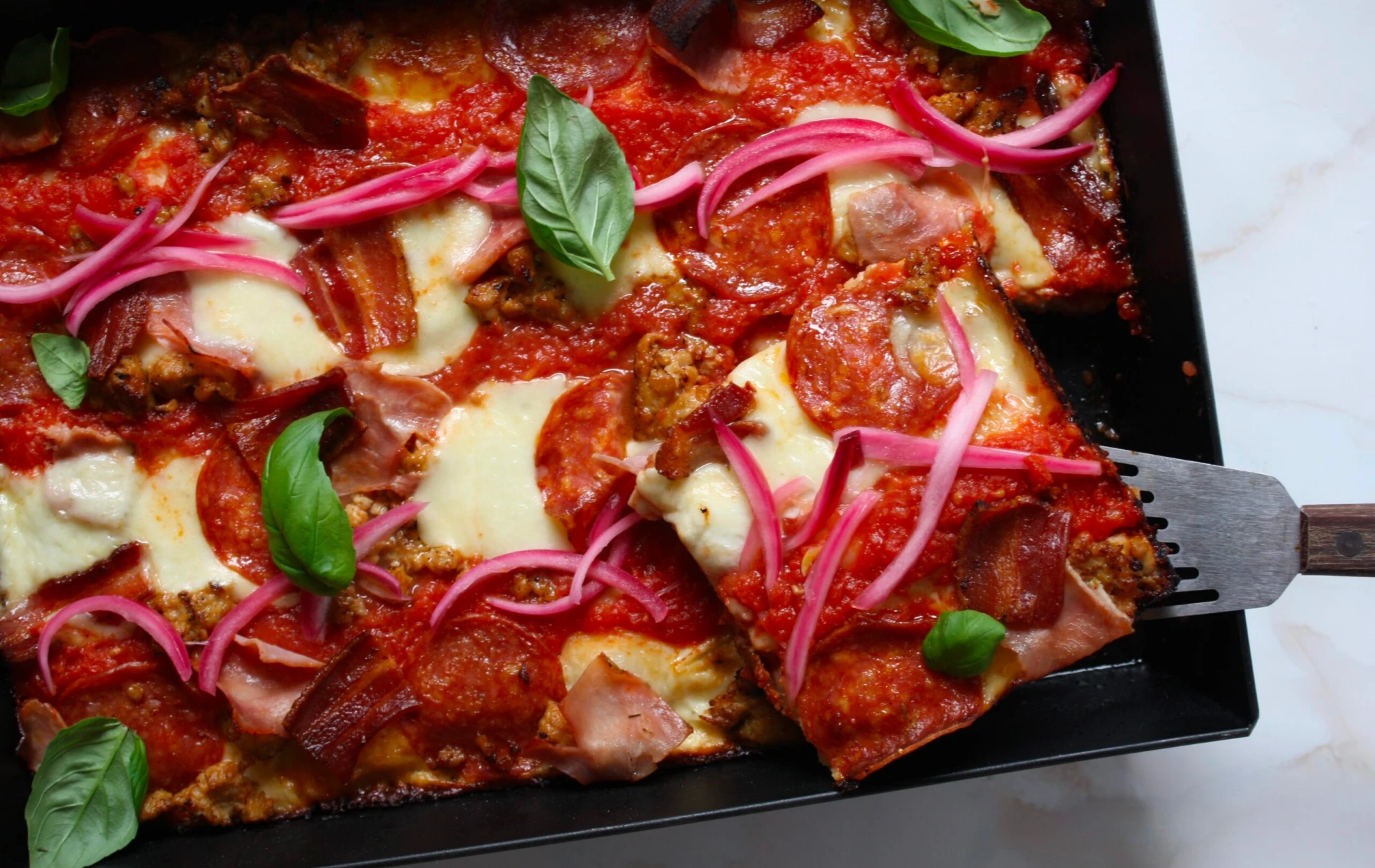
Detroit-style pizza originated in 1946 at Buddy’s in Detroit, where Gus Guerra adapted Sicilian techniques using blue steel automotive pans. This method created a thick, airy crust with crispy, caramelized edges. Unlike Sicilian pizza, cheese is layered directly on the dough and pushed to the edges, with sauce added on top. This signature approach creates a rich texture and deeply caramelized finish.
Drawing inspiration from the blue steel utility trays used in Detroit’s automotive plants, Guerra decided to use these pans to create a deep-dish pizza inspired by Sicilian traditions.
Detroit-style pizza features a thick, crispy crust with caramelized edges, whereas Sicilian-style pizza has a thick, airy, and bread-like crust. In Detroit-style pizza, the cheese is layered underneath the toppings, while Sicilian-style pizza layers the toppings on top of the sauce and cheese.One of the defining elements of Detroit pizza is its topping of "Brick cheese"—a semi-hard, smear-ripened cheese made from cow’s milk, first developed in Wisconsin in the late 1800s. The cheese gets its name from the bricks originally used to press out the moisture. Young brick cheese has a milky flavor with a subtle nuttiness, while the aged variety develops more complex, pungent, and tangy flavors.

Step 1
Combine flour, warm water, olive oil, yeast, and salt in a stand mixer or large bowl. Mix until a rough dough forms, then knead for 4–5 minutes in a mixer or 8–10 minutes by hand until smooth and elastic.
Step 2
Transfer dough to a generously oiled 9x13-inch pan. Turn to coat and gently press into a rough shape. Cover and proof at room temperature for about 2 hours, until doubled in size.
Step 3
Stretch the dough to fit the pan without deflating. Cover and proof for an additional 20–30 minutes until slightly puffy.
Step 1
Preheat oven to 450°F (232°C).
Step 2
Drain excess liquid from tomatoes and pulse until slightly chunky.
Step 3
Heat olive oil in a saucepan over medium heat. Add garlic and cook for 2–3 minutes until fragrant.
Step 4
Add tomatoes and simmer for 10–15 minutes until slightly thickened. Stir in salt and oregano, then cool.
Step 1
Whisk water, vinegar, sugar, and salt until dissolved.
Step 2
Add sliced onions and let sit at room temperature for at least 1 hour.
Step 3
Refrigerate until ready to use.
Assembly and Baking
Step 1
Press brick cheese along the edges of the dough, then distribute remaining cheese evenly across the surface.
Step 2
Bake for 7–9 minutes until cheese begins to melt and lightly brown.
Step 3
Remove from oven and spoon sauce in 2–3 lines across the top. Add mozzarella and distribute pepperoni, sausage, ham, and bacon evenly.
Return to oven and bake for 5–10 minutes until golden brown, edges are caramelized, and internal temperature reaches 200–210°F (93–99°C).
Remove from pan, garnish with basil and pickled red onions, slice, and serve.