Unlock this content with a Rosendale Online subscription.
Get unlimited access to all of Rosendale Online.
Already a Rosendale Online member?
Log in
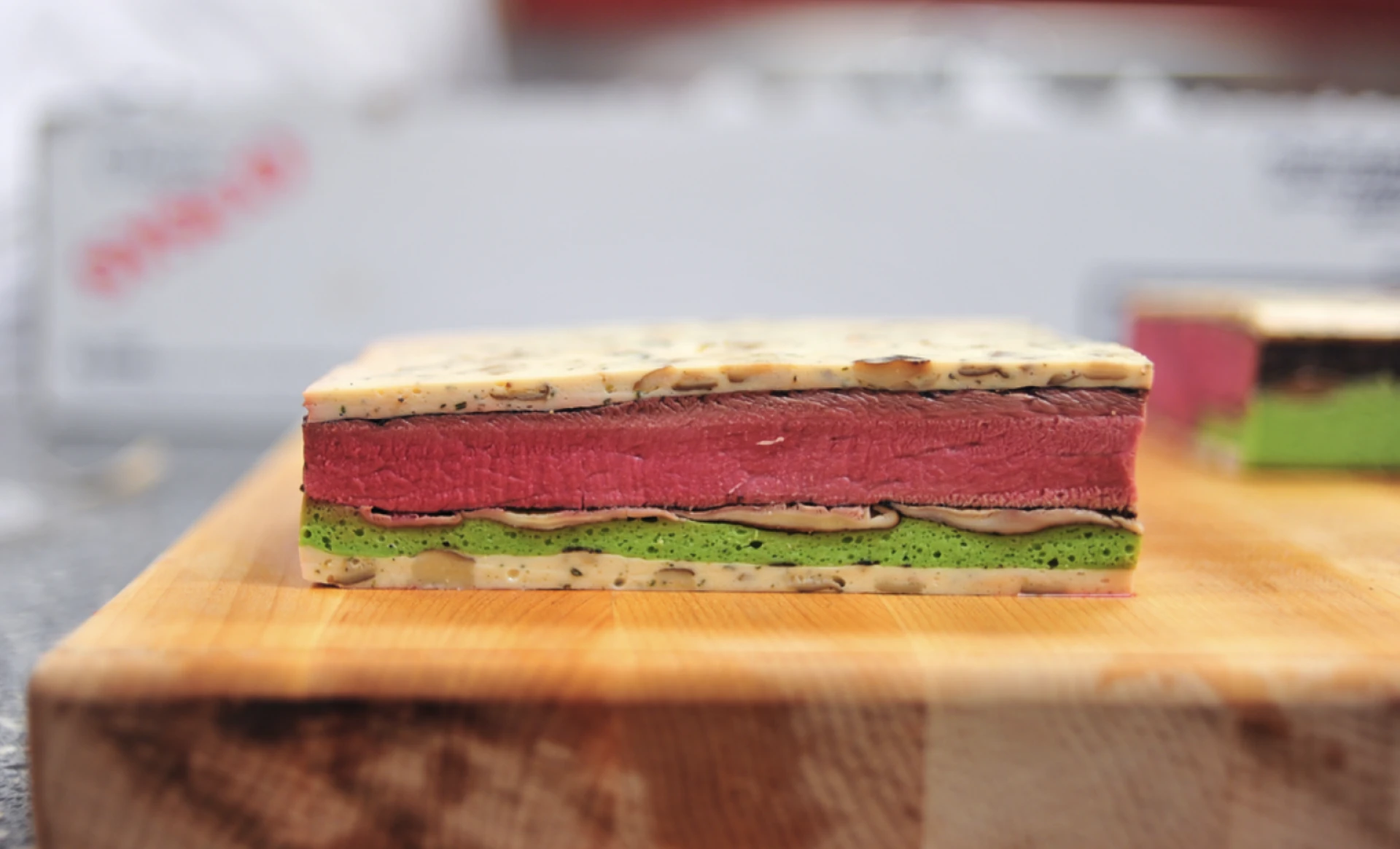
The Beef Tenderloin Pavé is an architectural expression of protein, built through disciplined layering, controlled compression, and precise temperature management.
Mushroom mousse mats frame a chlorophyll-infused mousse and carefully trimmed tenderloin core, creating clean horizontal geometry and structural integrity throughout the slice. Inspired by architectural principles and guided by technical accuracy from emulsification through final carving, this preparation demands discipline at every stage. The final cross-section reveals uniform protein set, vivid chlorophyll contrast, and precise alignment, a composition where structure is intentional, not decorative.
Step 1
Combine all ingredients in a Paco Jet beaker, laying the mixture flat.
Step 2
Freeze overnight.
Step 3
Pacotize. Keep the mixture below 40°F(4°C) at all times.
Step 4
With machine running, slowly stream in cold heavy cream to form a stable emulsion. Maintain mixture below 40°F(4°C) at all times.
Step 5
Reserve refrigerated at 32–36°F(0°C-2.2°C)until needed.
Step 1
Fold fully reduced and chilled mushroom duxelles into base chicken mousse until evenly distributed. Adjust seasoning.
Step 2
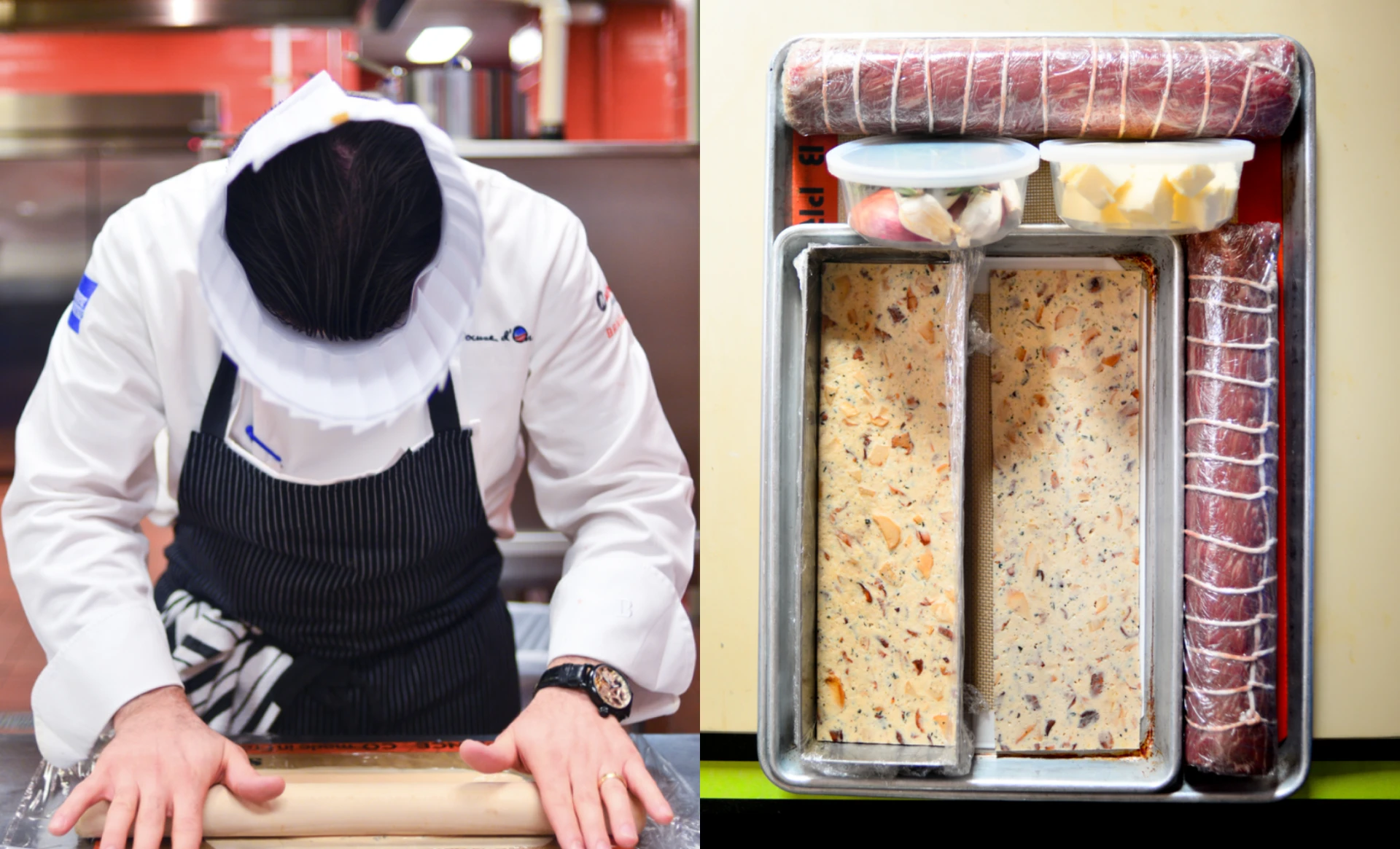
Spread mixture evenly between two silicone baking mats using a rolling pin to achieve uniform thickness of approximately 1/16 inch.
Step 3
Bake at 340°F(171°C) for 2 minutes to lightly set surface structure without browning.
Step 4
Cool completely.
Step 5
Trim into two precise rectangles measuring 9 × 4 inches to match mold dimensions.
Step 1
Combine water, spinach, parsley, basil, chives, and thyme in a high-powered blender.
Step 2
Secure lid and begin blending on low speed, gradually increasing to high until completely liquefied and uniformly bright green.
Step 3
Strain through a fine mesh chinois and discard pulp. Retain only the green liquid.
Step 4
Transfer liquid to a heavy-bottomed pot and bring gently to a simmer.
Step 5
As the liquid heats, skim the green chlorophyll raft that rises to the surface.
Step 6
Prepare a 32-ounce clear container fitted with cheesecloth secured by a rubber band. Place ice inside to chill the liquid that will drip through.
Step 7
Transfer the chlorophyll raft directly into the cheesecloth.
Step 8
Allow to drain for 15 minutes in the refrigerator. Discard the remaining green water.
Step 9
Reserve chlorophyll concentrate refrigerated until needed.
Step 1
Combine all ingredients in a Paco Jet beaker, laying the mixture flat.
Step 2
Freeze overnight.
Step 3
Pacotize to a smooth, vibrant green mousse.
Step 4
Freeze until firm.
Step 5
Pacotize to achieve a smooth, vibrant green mousse.
Step 6
Hold at 32–36°F(0°C-2°C) until assembly.
Step 1
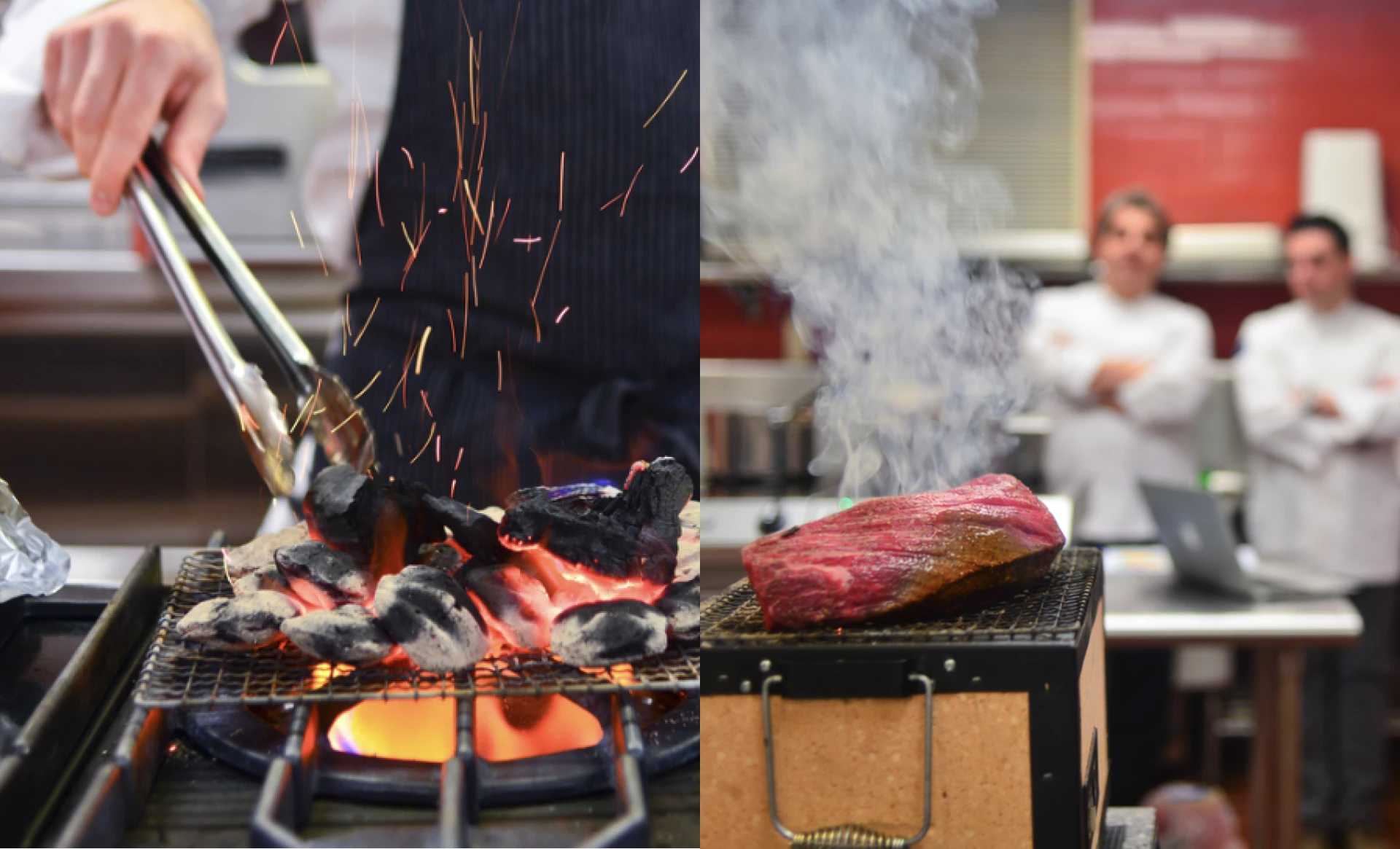
Char trimmed tenderloin evenly over binchotan or high-heat charcoal to develop surface crust without significantly increasing internal temperature.
Step 2
Chill immediately to halt carryover cooking.
Step 3
Split tenderloin lengthwise into two uniform halves sized to fit mold.
Step 1
Spray mold lightly and line with plastic wrap.
Step 2
Place one mushroom mat at bottom of mold.
Step 3
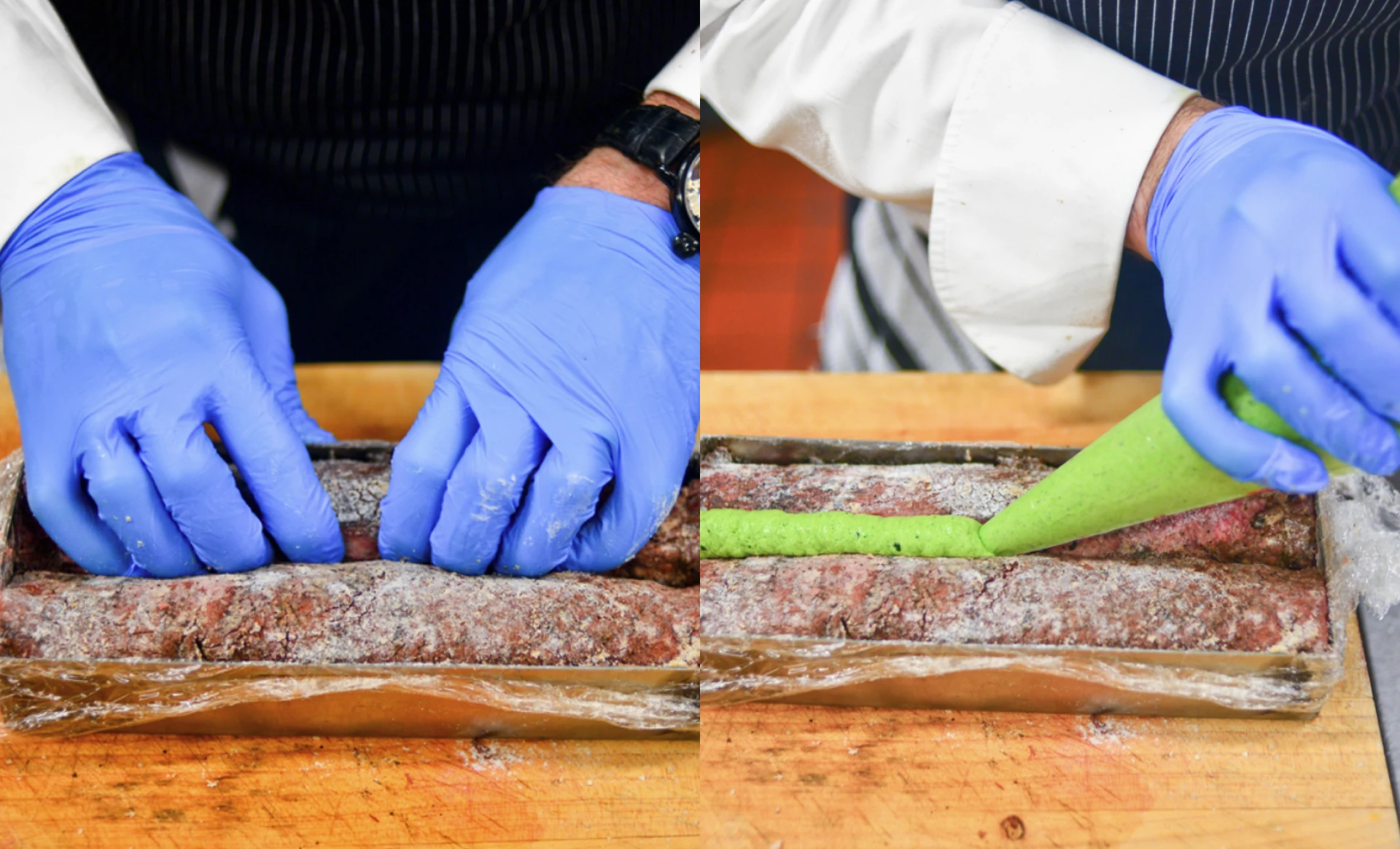
Position split tenderloin halves inside mold.
Step 4
Dust lightly and evenly with transglutaminase. Allow 5–10 minutes for hydration.
Step 5
Pipe chlorophyll mousse evenly around and over beef, ensuring full coverage.
Step 6
Tap mold lightly and smooth surface to eliminate air pockets.
Step 7
Place second mushroom mat on top.
Step 8
Apply plexiglass compression template and ensure even pressure across entire surface.
Step 9
Place assembled mold into a vacuum bag.
Step 10
Seal using an external suction vacuum sealer. Do not use a chamber vacuum machine, as excessive vacuum pressure may distort mousse structure.
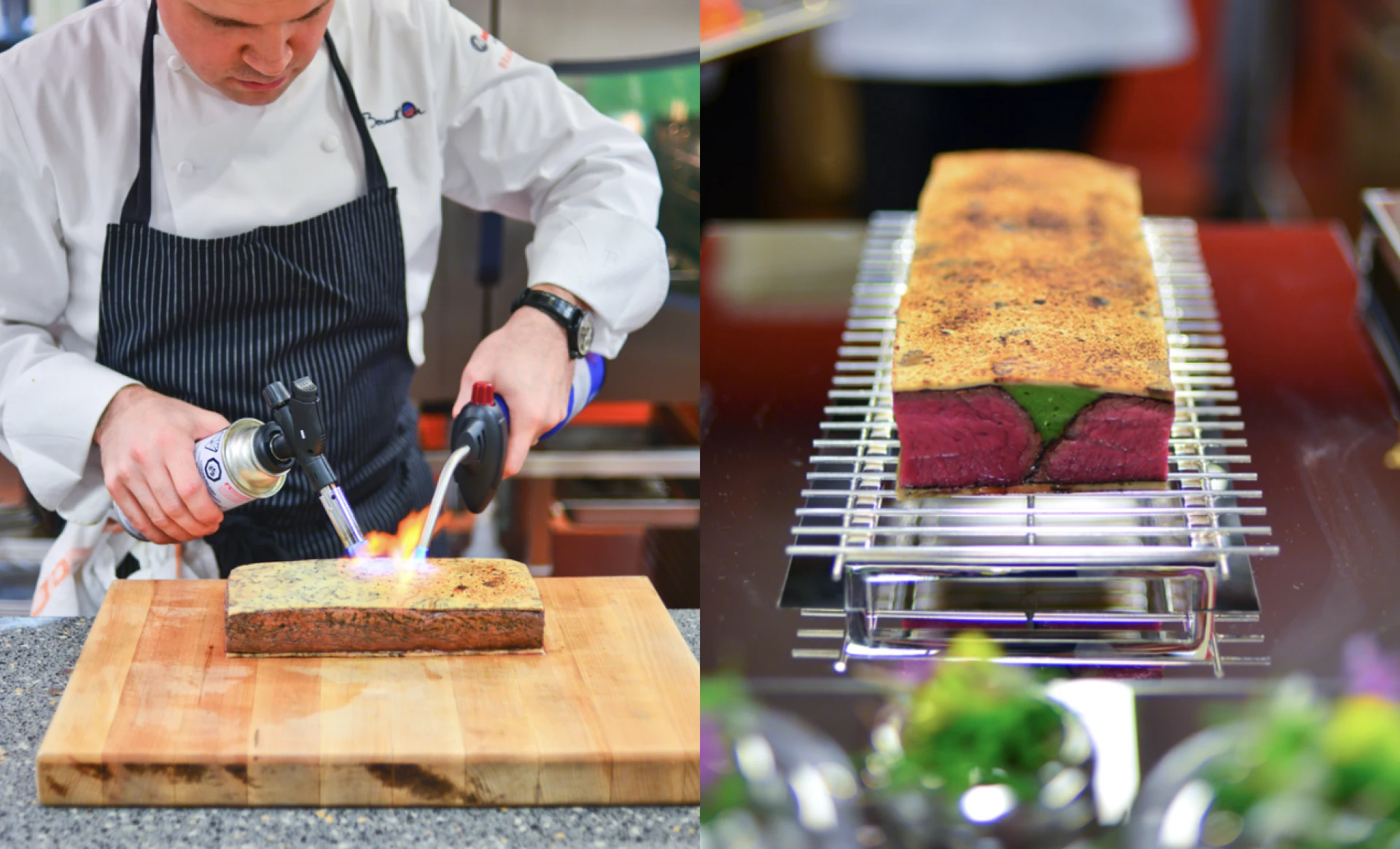
Step 1
Cook in a 147°F (64°C) water bath until internal temperature reaches 128°F(53°C), approximately 1 hour 15 minutes.
Step 2
Remove immediately once target temperature is achieved.
Step 3
Rest 10–15 minutes under light compression before unmolding.
Step 4
Lightly torch exterior to refresh crust.
Step 5
Brush with rendered beef fat and garlic oil blend.
Step 6
Slice with a warmed slicing knife in a single clean draw motion to reveal precise horizontal layers.